
One of my favourite ways to make jewellery with polymer clay is to use a polymer clay cane. However, learning how to make canes can be a frustrating process. There are many ways they can go wrong. You might even cut into your finished cane, only to find that it doesn’t look anything like you intended.
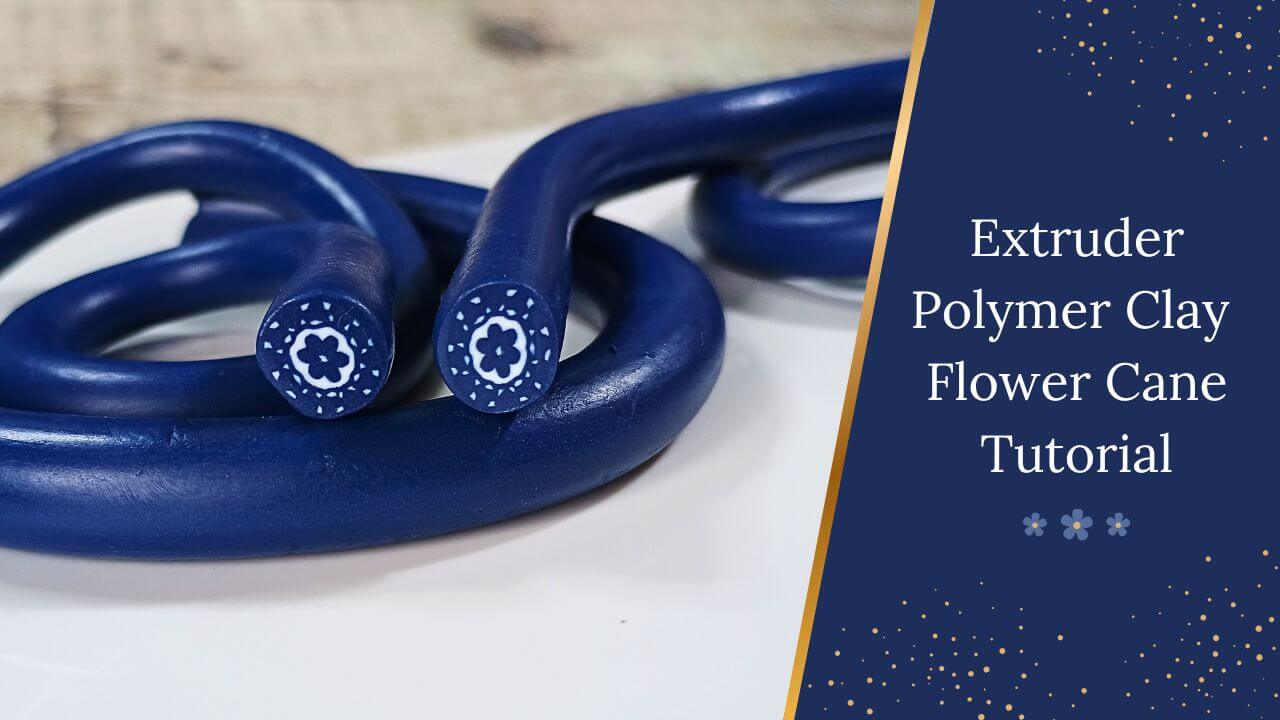
I think that this technique though is pretty much fool proof. I used it back in 2019 to make this extruder polymer clay flower cane tutorial and got great results. I have used it again now and was equally as pleased with the results. The secret to a structured and consistent polymer clay cane – using a polymer clay extruder.
In this post, I will discuss what a polymer clay cane is, what a clay exruder is and why it is great for making canes plus I will share useful hints and tips for cane building. I will also share the video I have made of the process.
This isn’t a typical step by step tutorial as I was mainly aiming to make jewellery for my Etsy shop. I did though, record the process. I have edited it and hopefully, it is easy to see what I am doing in the video (linked below).
What is a Polymer Clay Cane
A polymer clay cane is a long length of clay with a pattern running all through its length. You build a cane by starting with the detail at the centre of the cane. You then add more detail and surround it with more clay. A polymer clay cane can be of any picture or pattern that you like – I have seen incredible ones. If you can figure out how to make it in clay then it is possible.
Once you have added all the details to your cane, it is reduced to make it smaller. Once the cane is reduced, slices are cut and it can be used in various projects.

What is a Polymer Clay Extruder
A polymer clay extruder is a long barrel tool with an open screw top. There is a handle on the other end. When you buy your extruder you will also get a selection of metal discs with various shapes cut out of them. Conditioned polymer clay is put in the barrel of the extruder and a disc is put in the open space in the screw top. When the handle is turned, the clay is forced through the disc in the shape cut out on the disc.
There are several different brands of extruder available to buy but they all come with similar discs.
Why is an Extruder Great for Making Polymer Clay Canes
To put it simply, the clay extruder makes the clay the same size all the way down it’s length. There is no variation as the metal disc dictates the shape and thickness of the clay. In this cane I used a teardrop disc to shape the clay into petal shapes. I then cut this length of clay into 7cm pieces and arranged to form a flower shape. By doing this, I know that the flower shape is the same at the top as it is all the way down to the other end.
The extruder also enables me to make long thin snakes of clay that are very useful for filling small fiddly gaps in my cane. Rolling them that thinly and of consistent thickness would be very tricky!
As long as care is taken to line up the extruded pieces of clay all the way down their lengths, as is desired in the pattern, then the cane image should build without too much difficulty.

Tips for Successful Cane Building
When building your cane you need to ensure that your pieces of clay are a consistent size. For example, if you are adding a triangle to your cane and your cane is 3cm long you would need your triangle shape to be the same all the way down the 3cm length. Being consistent with your clay pieces one of the first steps to having a successful cane.
I also learned the hard way not to work with too little clay. It is tempting to not want to ‘waste’ clay by using a lot when learning to make canes. Making a very short cane though means that it can be difficult to reduce. Reducing the cane also causes distortion at the ends so you may end up with very little usable cane. I tend to build my canes about 4cm long, or longer, and then reduce them down.
My third tip for making a successful cane is to ensure that there are no air pockets in the cane and that any gaps are filled with more clay. The clay inside the cane supports each other. If there are large gaps in the clay, during reduction, the clay will spread into any open spaces resulting in a distorted image.
Colour combinations are also important when making a cane. Colours that are too similar will make a pattern that lacks definition. For this reason, high contrasting colours work well as does adding a layer of white or black between shapes.
The last tip is to make sure that when adding to your cane the clay is lined up all the way along. Check both ends and take your time to make sure that the clay in lying straight down the cane.
Polymer Clay Flower Cane – Making a Cane with an Extruder
I have covered in this blog post how to use a polymer clay cane to make jewellery . Check that out if you would like to know how to use your finished cane.
I made a large selection of beads and pendants with mine and I still have more cane left!

If you would like any more canes made like this let me know. It’s quite addictive once you get started!
Thanks for reading,
Hannah x

 The Artisan Duck
You are so good at this. I hope to get back to clay work some day soon.
Thank you so much. I don’t make canes as much as I would like. I hope you manage to get back to clay work ❤️